
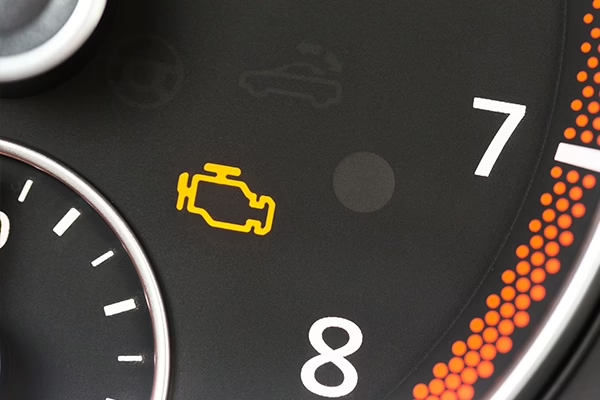
That amber icon on your dashboard gets your attention immediately when it comes on, and for good reason. The check engine light (CEL) is your vehicle’s way of telling you something in the engine or emissions system needs attention. But because it can signal anything from a loose gas cap to a failing catalytic converter, it’s easy to feel unsure about how urgent the problem actually is and what the next steps are for your vehicle.
Understanding common causes of a check engine light can help you make educated repair decisions and get your vehicle back into great running condition. Here are some of the most frequently-seen causes of CELs you should know and what they could mean for the health of your vehicle.
Steady vs. Flashing
Before anything else, it’s vital to look at how the light is behaving. A steady check engine light means something is outside normal operating parameters, but your vehicle is generally still safe to drive to a trusted local repair facility. Schedule a diagnostic appointment as soon as possible when you notice it.
A flashing check engine light is a different situation. Flashing indicates an active misfire, meaning one or more cylinders is unable to properly combust for a variety of possible reasons. Misfires can quickly cause damage to catalytic converters as a result of unburnt fuel being injected into a hot exhaust system. This excess heat and combustion within the catalytic converter can cause the component to fail internally, leading to an often costly replacement. If your light is flashing, avoid driving the vehicle entirely and have it towed to an automotive professional for diagnostics and repair.
The Most Common Causes of a Check Engine Light
Oxygen Sensor Failure
The oxygen sensor measures unburned oxygen in the exhaust stream and helps the engine control unit (ECU) to maintain the proper air-to-fuel ratio. A failed O2 sensor won’t immediately disable your vehicle, but it will cause the engine to run rich or lean, reduce fuel economy, and eventually damage the catalytic converter if left unaddressed.
Loose or Faulty Gas Cap
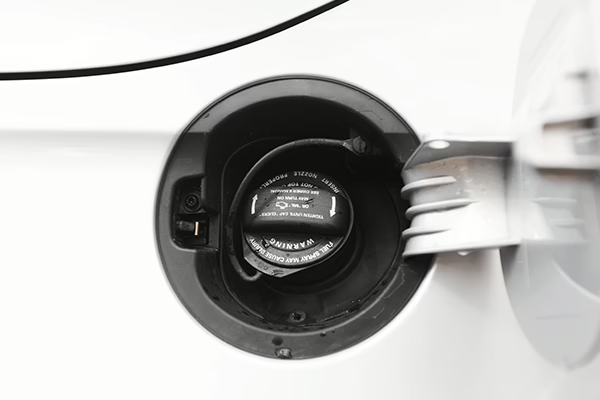
A missing or improperly seated gas cap allows fuel vapors to escape from the fuel tank, triggering the evaporative emission control (EVAP) system to flag a leak. It’s worth checking before assuming a more involved repair is needed, as it’s easy to forget to properly tighten the cap after pumping gas. Simply retighten the cap until it clicks and see if the light clears after a few drive cycles. If the cap itself happens to be cracked or the seal is worn, replacement is inexpensive.
Catalytic Converter
The catalytic converter reduces harmful exhaust emissions by converting carbon monoxide, hydrocarbons, and nitrogen oxides into less harmful compounds. When it fails, often due to neglected O2 sensors or engine misfires, you’ll typically notice reduced engine performance and a rotten egg-like smell from the exhaust. Catalytic converter replacement is often one of the more costly repairs due to their precious metal internals such as platinum or palladium , which is exactly why catching upstream issues early matters.
Mass Airflow Sensor
The mass airflow (MAF) sensor, located near the engine air intake, measures the amount of air entering the engine so the ECU can maintain a precise air-fuel ratio. A dirty or failing MAF sensor causes rough idling, hesitation under acceleration, and poor fuel economy. This sensor is sensitive to contamination from oil residue or a damaged air filter, which is another good reason to keep up with routine air filter changes.
Spark Plugs and Ignition Coils
Worn spark plugs or a failing ignition coil cause the engine to misfire, which shows up as a rough idle, hesitation, or a noticeable loss of power. On modern vehicles, each cylinder typically has its own ignition coil, meaning a single faulty coil triggers a specific cylinder misfire code. Spark plugs are wear items and should be replaced according to your vehicle’s service interval, ignoring them long enough often leads to coil damage.
EVAP System Leaks
The evaporative emission control system prevents fuel vapors from escaping into the atmosphere. A leak anywhere in the system triggers an EVAP fault code, including the fuel cap as we discussed above. These can be tricky to diagnose without a smoke machine, but are worth addressing both for emissions compliance and fuel efficiency.
Why Professional Diagnosis Matters
Consumer-grade OBD-II scanners can read the fault code stored in your engine control module, but a code is only a starting point, not a diagnosis. The code tells you which system reported a problem, not which component failed or why. Getting down to the true source of your problem requires further diagnostics and testing that often require specialized scanners and equipment.
Check Engine Light Diagnostics at Sun Automotive
The technicians at Sun Automotive are equipped with advanced diagnostics equipment and the experience needed to provide your vehicle with an accurate diagnostic and timely repair. No matter the reason behind your CEL, our team can pinpoint your precise issue and the next steps for your vehicle.
A check engine light that clears on its own is still worth noting. Intermittent codes often indicate a problem that will return, and ignoring them typically means a more involved repair later.
If you’re experiencing that a CEL on your dash, the ASE-certified technicians at any of our four locations across Eugene, Springfield, and Junction City can perform a full diagnostic scan and give you a clear picture of what’s going on. Schedule an appointment online or give us a call today!